m.e.s
HEH was a big fuck off to the music industry. It was probably the first time I'd got to the point where I knew I was alone with my ideas. And you can go one of two ways: either you curb your thinking, rein yourself in and buy what they're telling you, or you follow your own path, regardless.
And so I just went for it on that album. But, I must admit, throughout parts of the recording I thought that this is it. This is the last one we're going to do. To a certain extant I always think like that, with every album - even now. But the feeling was a lot more acute with Hex. When you're mired in the shit of the times with bland bastards like Elvis Costello and Spandau Ballet, you start to question not only people's tastes but their existences. You're not going anywhere with all that shit. I wanted an album to be like reading a really good book. You have a couple of beers, sit down and immerse yourself. None of those fuckers did that. I don't even think they attempted it. I'd rather listen to the Polish builders clanking away next door than any of that crap.
k-punk
Mark Sinker: 'Scrawny, gnarled, gaunt: Smith doesn't waltz with ghosts. He materialises them.'
Who can put their finger on the Weird?
It’s taken me more than twenty years to attempt this deciphering. Back then, the Fall did something to me. But what, and how?
Let’s call it an Event, and at the same time note that all Events have a dimension of the uncanny. If something is too alien, it will fail to register; if it is too easily recognized, too easily cognizable, it will never be more than a reiteration of the already known. When The Fall pummeled their way into my nervous system, circa 1983, it was as if a world that was familiar - and which I had thought too familiar, too quotidian to feature in rock - had returned, expressionistically transfigured, permanently altered.
I didn't know then, that, already, in 1983, The Fall's greatest work was behind them. No doubt the later albums have their merits but it is on Grotesque (1980), Slates (1981) and Hex Enduction Hour (1982) where group the reached a pitch of sustained abstract invention that they - and few others - are unlikely to surpass. In its ambition, its linguistic inventiveness and its formal innovation, this triptych bears comparison with the great works of twentieth century high literary modernism (Joyce, Eliot, Lewis). The Fall extend and performatively critique that mode of high modernism by reversing the impersonation of working class accent, dialect and diction that, for example, Eliot performed in The Waste Land. Smith’s strategy involved aggressively retaining accent while using - in the domain of a supposedly popular entertainment form - highly arcane literary practices. In doing so, he laid waste the notion that intelligence, literary sophistication and artistic experimentalism are the exclusive preserve of the privileged and the formally educated.
But Smith knew that aping master class morés presented all sorts of other dangers; it should never be a matter of proving (to the masters) that the white crap could be civilized. Perhaps all his writing was, from the start, an attempt to find a way out of that paradox which all working class aspirants face - the impossiblility of working class achievement. Stay where you are, speak the language of your fathers, and you remain nothing; move up, learn to speak in the master language, and you have become a something, but only by erasing your origins - isn't the achievement precisely that erasure? ('You can string a sentence together, how can you possibly be working class, my dear?')
The temptation for Smith was always to fit into the easy role of working class spokesman, speaking from an assigned place in a given social world. Smith played with that role ('the white crap that talks back', 'Prole Art Threat', 'Hip Priest') whilst refusing to actually play it. He knew that representation was a trap; Social Realism was the enemy because in supposedly 'merely' representing the social order, it actually constituted it. Against the Social Realism of the official left, Smith developed a late twentieth century urban English version of the 'grotesque realism' Bakhtin famously described in Rabelais and his World. Crucial to this grotesque realism is a contestation of the classificatory system which deems cultures (and populations) to be either refined or vulgar. As Peter Stallybrass and Allon White argued, 'the grotesque tends to operate as a critique of a dominant ideology which has already set the terms of, designating what is high and low'.
Instead of the high modernist appropriation of working class speech and culture, Smith's pulp modernism reacquaints modernism with its disavowed pulp doppelganger. Lovecraft is the crucial figure here since his texts - which first appeared in pulp magazines like Weird Tales - emerged from an occult trade between pulp horror and modernism. Follow the line back from Lovecraft's short stories and you pass through Dunsany and M R James before coming to Poe. But Poe, also played a decisive role in the development of modernism - via his influence on Baudelaire, Mallarmé, Valéry and their admirer T.S. Eliot. The Waste Land’s debt to Dracula, for instance, is well-known. The fragmentary, citational structure of a story like Lovecraft's ‘Call of Cthulhu’, meanwhile, recalls The Waste Land. More than that: as Benjamin Noys argued in his paper 'Lovecraft the Sinthome' the abominations from which Lovecraft’s strait-laced scholars recoil bear comparisons with cubist and futurist art: Lovecraft, that is to say, turns modernism into an object of horror.
The textual expectorations of Hex
Hex press release: 'He'd been very close to becoming ex-funny man celebrity. He needed a good hour at the hexen school...'
Hex Enduction Hour was even more expansive than Grotesque. Teeming with detail, gnomic yet hallucinogenically vivid, Hex was a series of pulp modernist pen portraits of England in 1982. The LP had all the hubristic ambition of Prog combined with an aggression whose ulcerated assault and battery outdid most of its postpunk peers in terms of sheer ferocity. Even the lumbering ‘Winter’ was driven by a brute urgency, so that, on Side One, only the quiet passages in the lugubrious ‘Hip Priest’ – like dub if it had been invented in drizzly motorway service stations rather than in recording studios in Jamaica – provided a respite from the violence.
Yet the violence was not a matter of force alone. Even when the record's dual-drummer attack is at its most poundingly vicious, the violence is formal as much as physical. Rock form is disassembled before our ears. It seems to keep time according to some system of spasms and lurches learned from Beefheart. Something like ‘Deer Park’ – a whistle-stop tour of London circa 82 sandblasted with ‘Sister Ray’-style white noise - screams and whines as if it is about to fall apart at any moment. The ‘bad production’ was nothing of the sort. The sound could be pulverisingly vivid at times: the moment when the bass and drums suddenly loom out of the miasma at the start of ‘Winter’ is breathtaking, and the double-drum tattoo on ‘Who Makes the Nazis?’ fairly leaps out of the speakers. This was the space rock of Can and Neu! smeared in the grime and mire of the quotidian, recalling the most striking image from The Quatermass Xperiment: a space rocket crashlanded into the roof of a suburban house.
In many ways, however, the most suggestive parallels come from black pop. The closest equivalents to the Smith of Hex would be the deranged despots of black sonic fiction: Lee Perry, Sun Ra and George Clinton, visionaries capable of constructing (and destroying) worlds in sound.
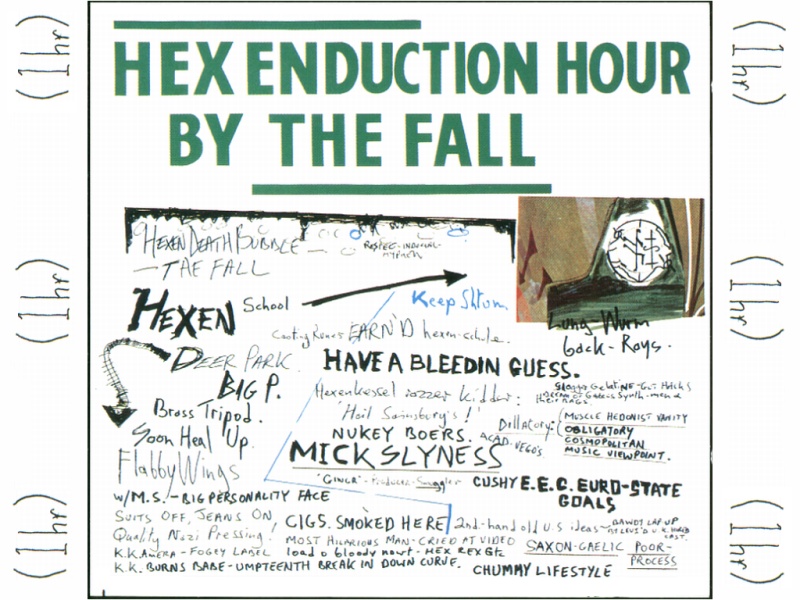
As ever, the album sleeve (so foreign to what were then the conventions of sleeve design that HMV would only stock it with its reverse side facing forward) was the perfect visual analogue for the contents. The sleeve was more than that, actually: its spidery scrabble of slogans, scrawled notes and photographs was a part of the album rather than a mere illustrative envelope in which it was contained.
With The Fall of this period, what Gerard Genette calls ‘paratexts’ – those liminal conventions, such as introductions, prefaces and blurbs, which mediate between the text and the reader – assume special significance. Smith’s paratexts were clues that posed as many puzzles as they solved; his notes and press releases were no more intelligible than the songs they were nominally supposed to explain. All paratexts occupy an ambivalent position, neither inside nor outside the text: Smith uses them to ensure that no definite boundary could be placed around the songs. Rather than being contained and defined by its sleeve, Hex haemorrhages through the cover.
It was clear that the songs weren’t complete in themselves, but part of a larger fictional system to which listeners were only ever granted partial access. ‘I used to write a lot of prose on and off,’ Smith would say later. ‘When we were doing Hex I was doing stories all the time and the songs were like the bits left over.’ Smith’s refusal to provide lyrics or to explain his songs was in part an attempt to ensure that they remained, in Barthes’ terms, writerly. (Barthes opposes such texts, which demand the active participation of the reader, to ‘readerly’ texts, which reduce the reader to the passive role of consumer of already-existing totalities.)
Before his words could be deciphered they had first of all to be heard, which was difficult enough, since Smith’s voice – often subject to what appeared to be loud hailer distortion - was always at least partially submerged in the mulch and maelstrom of Hex’s sound. In the days before the internet provided a repository of Smith’s lyrics (or fans’ best guesses at what the words were), it was easy to mis-hear lines for years.
Even when words could be heard, it was impossible to confidently assign them a meaning or an ontological ‘place’. Were they Smith’s own views, the thoughts of a character or merely stray semiotic signal? More importantly: how clearly could each of these levels be separated from one another? Hex’s textual expectorations were nothing so genteel as stream of consciousness: they seemed to be gobbets of linguistic detritus ejected direct from the mediatized unconscious, unfiltered by any sort of reflexive subjectivity. Advertising, tabloid headlines, slogans, pre-conscious chatter, overheard speech were masticated into dense schizoglossic tangles.
Who wants to be in a Hovis advert any way?
‘Who wants to be in a Hovis/ advert/ any way?’ Smith asks in ‘Just Step S’ways’, but this refusal of cosy provincial cliche (Hovis adverts were famous for their sentimentalised presentation of a bygone industrial North) is counteracted by the tacit recognition that the mediatized unconscious is structured like advertising. You might not want to live in an advert, but advertising dwells within you. Hex converts any linguistic content – whether it be polemic, internal dialogue, poetic insight – into the hectoring form of advertising copy or the screaming ellipsis of headline-speak. The titles of ‘Hip Priest’ and ‘Mere Pseud Mag Ed’, as urgent as fresh newsprint, bark out from some Voriticist front page of the mind.
As for advertising, consider ‘Just Step S’ways’’ opening call to arms: ‘When what you used to excite you does not/ like you’ve used up all your allowance of experiences’. Is this an existentialist call for self re-invention disguised as advertising hucksterism, or the reverse? Or take the bilious opening track, ‘The Classical’. ‘The Classical’ appears to oppose the anodyne vacuity of advertising’s compulsory positivity (‘this new profile razor unit’) to ranting profanity (‘hey there fuckface!’) and the gross physicality of the body (‘stomach gassss’). But what of the line ‘I’ve never felt better in my life?’ Is this another advertising slogan or a statement of the character’s feelings?
It was perhaps the unplaceability of any of the utterances on Hex that allowed Smith to escape censure for the notorious line, ‘where are the obligatory niggers?’ in ‘The Classical’. Intent was unreadable. Everything sounded like a citation, embedded discourse, mention rather than use.
Smith returns to the Weird tale form on ‘Jawbone and the Air Rifle’. A poacher accidentally causes damage to a tomb, unearthing a jawbone which ‘carries the germ of a curse/ of the Broken Brothers Pentacle Church’. The song is a tissue of allusions - James (‘A Warning to the Curious’, ‘Oh, Whistle and I’ll Come to you, my Lad’), Lovecraft (‘The Shadow over Innsmouth’), Hammer Horror, The Wicker Man - culminating in a psychedelic/ psychotic breakdown (complete with torch-wielding mob of villagers):
He sees jawbones on the street/ advertisements become carnivores/ and roadworkers turn into jawbones/ and he has visions of islands, heavily covered in slime. / The villagers dance round pre-fabs/ and laugh through twisted mouths
‘Jawbone’ resembles nothing so much as a League of Gentlemen sketch, and The Fall have much more in common with the League of Gentlemen’s febrile carnival than with witless imitators such as Pavement. The co-existence of the laughable with that which is not laughable: a description that captures the essence of both The Fall and The League of Gentlemen's grotesque humour.
White Face finds roots
On Hex’s second side, mutant r and r becomes r and Artaud as the songs become increasingly delirial and abstract. 'Who Makes the Nazis’ - as lunar as Tago Mago, as spacey-desolated as King Tubby at his most cavernous – is a TV talk show debate rendered as some Jarry-esque pantomime, and composed of leering backing vocals and oneiric-cryptic linguistic fragments: ‘longhorn breed… George Orwell Burmese police… Hate’s not your enemy, love’s your enemy, murder all bush monkeys…’
'Iceland', recorded in a lava-lined studio in Reykjavik , is a fantasmatic encounter with the fading myths of North European culture in the frozen territory from which they originated. ‘White face finds roots’ Smith’s sleeve-notes tell us. The song, hypnotic and undulating, meditative and mournful, recalls the bone-white steppes of Nico's The Marble Index in its arctic atmospherics. A keening wind (on a cassette recording made by Smith) whips through the track as Smith invites us to ‘cast the runes against your own soul’ (another James’ reference, this time to his ‘Casting the Runes’).
‘Iceland’ is rock as ragnarock, an anticipation (or is it a recapitulation) of the End Times in the terms of the Norse ‘Doom of the Gods’. It is a Twilight of the Idols for the retreating hobgoblins, cobolds and trolls of Europe’s receding Weird culture, a lament for the monstrosities and myths whose dying breaths it captures on tape:
Witness the last of the god men ….A Memorex for the Krakens