Two lengthy art pieces packing emotional punch. Cast-iron testament that the experimental and constructivist may cleave to the power to move.
Gavin Bryars is not light on methodological muscle, working across jazz, free improv, minimalism, avant-garde and neoclassicism. A founding member of the Portsmouth Sinfonia - an orchestra whose membership consisted of performers who “embrace the full range of musical competence” (there’s a euphemism in there somewhere). Sinfonia members included erstwhile pal Brian Eno whose Obscure Records label put out several Bryars works in the mid-70s including the Titanic piece herein.
Jesus' Blood Never Failed Me Yet (1971) loops around a field-recording of homeless man vocalising-improvising a hymn. Over the loop, are built rich harmonies, played by live ensemble; slowly increasing in density, and impact before gradual fade. The piece was first recorded for use in a documentary chronicle of street life in and around London’s Elephant and Castle:
When I played it at home, I found that his singing was in tune with my piano, and I improvised a simple accompaniment. I noticed, too, that the first section of the song - 13 bars in length - formed an effective loop which repeated in a slightly unpredictable way. I took the tape loop to Leicester, where I was working in the Fine Art Department, and copied the loop onto a continuous reel of tape, thinking about perhaps adding an orchestrated accompaniment to this. The door of the recording room opened on to one of the large painting studios and I left the tape copying, with the door open, while I went to have a cup of coffee. When I came back I found the normally lively room unnaturally subdued. People were moving about much more slowly than usual and a few were sitting alone, quietly weeping.
I was puzzled until I realised that the tape was still playing and that they had been overcome by the old man's singing. This convinced me of the emotional power of the music and of the possibilities offered by adding a simple, though gradually evolving, orchestral accompaniment that respected the tramp's nobility and simple faith. Although he died before he could hear what I had done with his singing, the piece remains as an eloquent, but understated testimony to his spirit and optimism.
- Bryars
The Sinking of the Titanic (1969), indeterministically allows performers to render various sound sources related to the sinking of the RMS Titanic. Cue heart-tugging, uplifting and perfectly poised melodic motifof Nearer My God To Thee / Amazing Grace against ambient backdrop of chilly ocean noise.
Oddi wrth y brawd
[Sundry bonus sunderings and landings in Comments]
Door-stepped by normal horror, Machen too not rudely treated by presumption. Mundane terror. Not Egypt but stinking boats of the Thames. Not the spineless usual sub-intellectual; not "tough" recycled cabaret glam three-chord big boots. White crap let loose in studio. Supernatural theme. "I used to be psychic but I drank my way out of it". Used to be folk devil lyric poet. Cue shouty sloganeering whisky descend. Shadow walks behind paranoia man trapped in Flat of Angles after killing wife. Bent sinister from start.
Cog-nisant:
part the first. Spectre vs rector
part the second. Inspector visits rector
part the third. Spectre possesses rector
part the fourth. Inspector versus rector possessed by spectre
part the fifth. Hero appears; his soul possessed a thousand times
part the sixth. Spectre enters hero; possession is ineffectual
In his early 70s psycho-pomp, Julius Arnest Caesar (J.A. Seazer / J.A. Ceaser) conjured some unique concoctions on behalf of Shuji Terayama’s Tenjo Sajiki Theatre Company. An experimental blend of kosmische rock, dappled with Noh stylings and witchy women choruses for added weirdness. Not too preposterously seen as distant cousin to ISB’s “U” – a surreal parable in song and dance, as performed by Black Sabbath.
[Bonus in Comments: "Music that evokes the Khanate Golden Horde invading eastern Turkey, anyone? Yes, please."]
Massively pre-dating n outmaneuvering Mr Reed's Metal Machine Music in the ear-cleaning stakes, here be Big Bang Minimalism; 20th century classical avant garde teetering on the edge of rock 'n' roll. Mind-numbing waves of amplified strings - check - slowly bowed overlapping drones - check - alienating and all enveloping sound distorting all sense of time and place - yes, please. (Transferred from decayed tape that occasionally staggers n stutters in thrilling fashion.)
Prescient and unprecedented tribute to indeterminacy, electronic hiss, ruptured nostalgia, guitar / siren wail, ghostly future times past, patriotism, distant bells, radio transmission, tape manipulation, hubristic pre-war swagger, and in the end, friendship. For all the artiness of the undertaking - avant garde to the core - "Opera" is intensely autobiographical and engaging.
Ichiyanagi compares music to Japanese garden design: meticulous, painfully ordered yet always interacting with indeterminate elements - moisture, light, wind. Despite the self-declared tilt at natural multiplicity over concentrated construct, the do-it-yourself flow of patchwork elements benefits from intimate aleatoric framing. The details look after themselves.
To Tadanori Yokoo, Japanese pop design magus. Like Ichiyanagi, Yokoo's multi-layered approach is highly personal and gives the lie to easy comparisons, notably "the Japanese Warhol" moniker. Modus operandi converge. Yokoo saturating and manipulating popular by-gone images in bang up to date lysergic colour; Ichiyanagi knitting traditional enka with musique concrète and psych feakout à la mode. Both artists tackle tricksy themes around nationalism and nationhood: Yokoo's risqué red sun ray flag (kyoku jitsu-ki) as recurring motif; Ichiyanagi's sampling of rousing miltary marching song. More cultural reclamation than the revivalist impulse that drove contemporary - and Yokoo friend and influence - Mishima Yukio.
The “Opera” is a multi-media affair; the importance attached to the visual side of the production well ahead of its time. Attention to sonic and visual detail - however indeterminate -as meticulous as traditional Japanese art and crafts. The work is ahead of its time in other ways.
Side A
1 Aria ichi [Aria one] Traditional ballad setting leit motif of melancholy nostalgia.
2 Erekutorikku chanto [Electric chant] More hiss and whine than chant. "Chant" well-chosen, nevertheless, as sickly electronic Buddhist drone morphs into air-raid siren. Cue martial brass band and military singing. Oppressive and rousing; attracting as it repels. 20 years later, the likes of Current 93 and Death In June would court controversy with similar use of Nazi martial tunes. No gimmicks here.
3 Otoko no junjo [Man’s pure heart] Distant noises, footsteps, two men feeling their way into a song on skeletal piano. Complaining about the piano, they notice the environing silence:
"Everybody’s gone – nobody is watching. Should we continue when there is no one?" Big question. Finally, free from background noise, the song is delivered in full.
Switch: crowd noise. Rumpus. Sports match? Riot? Protest? Woman sobbing - fear or erotic excitement?
Low-flying aircraft passes overhead.
(1966, a group of Narita locals tool up with student activists and left-wing politicos forming Sanrizuka-Shibayama Union to Oppose the Airport)
Side B
4 Uchida Yuya to Za Furawaazu (Uchida Yuya and the Flowers) 27-minute long psych free form freak out. 20 mins. one side, remainder on next. Ichiyanagi let loose the reins on budding young psychonauts with the sole stipulation that the piece be titled after Yokoo's signature 1965 poster I Was Dead.
The central slogan on Yokoo's poster: “Having reached a climax at the age of 29, I was dead". Inkling that Ichiyanagi is having a joke at young gun expense.
Side C
5 Uchida Yuya to Za Furawaazu (Uchida Yuya and the Flowers)
Caution, mind melting in progress. 7 more minutes.
6 Nyuyooku no uta [New York song] Poem recited in Edo-jidai Japanese, then contemporary dialogue and short monogatari.
At this point, check again Ichiyanagi's integration of Yokoo thematic riffs. For instance, the "Opera" shares imagistic and sonic links to Yokoo's 1965 animation Kach Kachi Yama:
7 Kayo myuzikare [Kayo musicale] Medley: radio jingles, random commentary, film excerpt (adult scolds initially recalcitrant but ultimately pliable young woman for accepting something from a stranger), and Meiji Chocolate ad given the full Group Sound treatment chokoreeto – chokoreeto. Switch: European church bells, harpsichord looped, echoed, deconstructed. Switch: sound of massive bombing raid. End.
Amounting to what? Let's venture: a comment on corrosive Western / capitalist influence? Whether low art or high - reedy GS organ peddling chocolate or god pandering Bach keyboard - the outcome obliterates.
Side D
8 Love Blinded Ballad Uta 1969 Archival announcements, patriotic songs, marching fanfares, speeches, classical violin, military songs intermixed curvilinear fashion. Whirlwind tour through 30s & 40s public sphere. Pervading unease and eeriness recalls Derrida's hauntology. Ichiyanagi way ahead of "nostalgia for the future" curve.
And blinded by love for what exactly? Patriotism....
9 Spite Song Uta 1969 Frogs croak, waterfowl cackle, crows caw; earlier patriotic choruses hover ghostly in the background. Tchaikovsky’s Swan Lake subjected to discordant squeaking as AM radio tunes in and out of romantic cliché to the point of unlistenability. Final transition to bombing alert siren comes as relief!
10 Takakura Ken, Tadanori Yokoo o utau [Ken Takakura sings to Tadanori Yokoo] Or is it more an "All Clear" signal? That would make sense as next and last up is enka serenade by yakuza movie hard man Takakura Ken.
Ichiyanagi's choice of Takakura Ken is apposite and affectionate. Tadanori Yokoo provided commercial posters for several of Takakura’s gangster flicks and was obviously enamoured.
And so, a warm, personal ending to a disquieting, shattering journey. Enjoy the trip.
Oh, the mordant wit and sinister resonance of prime Mr. Cutler. (Produced by pioneering ambient egg-head David Toop). Y brawd hadn't realised IC was a good synagogue going boy...though it all makes sense...these pieces sweat with dark sonorous Jewish melodies. Humane, skew whiff, moving.
intermedia: what happens when different media intersect; how found and everyday objects, sounds, images, and texts mix to create new combinations of objects, sounds, images, and texts.
simple: small scale, short texts, brief performances.
fun.
In other words, carte blanche for pissing about. Quite literally in La Ono's case. Y brawd invites you the listener to sort vacuous piffle from the really rather good. Let it flow.
01 Walter Marchetti: Per la sete dell'orecchio (1976)
02 Juan Hidalgo: Tamaran (1974)
03 La Monte Young: Dream house (1973)
04 Ben Vautier: Some ideas for Fluxus (1989)
05 Wolf Vostell: Elektronischer dé-coll/age. Happening Raum (1968)
06 Milan Knizak: Broken music composition (1979) 3:26
07 Robert Filliou: Imitating the sound of the birds (1979)
08 Alison Knowles: Natural assemblage. Le vrai courbeau (1984)
09 Emmett Williams: Duet (1968)
10 John Cage: Radio Music (1956)
11 Joseph Beuys: Sonne statt Reagan (1982)
12 Yoko Ono: Toilette Piece (1971)
13 Dick Higgins: B.B. finally dreams about life, B.B.'s you play it (1962)
14 Philip Corner: Car passing at night, country road in Maine (1988)
15 Eric Andersen: The untacti[c]s of music (1968)
16 Robert Watts: Interview (1963)
17 Nam June Paik: My jubilee ist unverhemmet (1977)
18 Ken Friedman: Orchestra requiem variations (1967)
01 Part I, Bach 02 Part II 03 Part III 04 Part IV 05 Part V 06 Part VI 07 Part VII 08. Part VIII, Bach (Remix #1) 09 Part IX 10 Part X 11 Part XI 12 Part XII, Bach (Remix #2) 13 Part XIII 14 Part XIV 15 Part XV 16 Part XVI, Bach (Remix #3) 17 Part XVII, Bach 2
Enter Takeshi Mizutani's world of total cultural assault. These late period recordings dial down squall n sub bass battering - juste un tad - and so present excellent point of entry for the uninitiated.
Also, featuring far out Rallizes stalwart Fujio Yamaguchi.
Live 14 Aug. 1980 1-1. 造花の原野 (7:21) 1-2. 夜より深 (16:16) 1-3. 白い目覚め (6:24)
Live 14 Aug. 1980 2-1. 夜、暗殺者の夜 (12:27) 2-2. Fantastique (13:06) 2-3. 夜の収穫者達 (8:32) 2-4.The Last One (27:50)
Live 29 Oct. 1980 3-1. 夜より深 (15:43) 3-2. 氷の炎 (19:27) 3-3. 夜より深 Part 2 (11:00)
Live 29 Oct. 1980 4-1. Enter The Mirror (12:20) 4-2. 夜、暗殺者の夜 (13:22) 4-3. The Last One (19:23)
Live 23 Mar. 1981 5-1. 夜、暗殺者の夜 (16:00) 5-2. 夜より深 Part 2 (30:41)
Live 23 Mar. 1981 6-1. The Last One (24:24) 6-2. 氷の炎 (20:57)
HEH was a big fuck off to the music industry. It was probably the first time I'd got to the point where I knew I was alone with my ideas. And you can go one of two ways: either you curb your thinking, rein yourself in and buy what they're telling you, or you follow your own path, regardless.
And so I just went for it on that album. But, I must admit, throughout parts of the recording I thought that this is it. This is the last one we're going to do. To a certain extant I always think like that, with every album - even now. But the feeling was a lot more acute with Hex. When you're mired in the shit of the times with bland bastards like Elvis Costello and Spandau Ballet, you start to question not only people's tastes but their existences. You're not going anywhere with all that shit. I wanted an album to be like reading a really good book. You have a couple of beers, sit down and immerse yourself. None of those fuckers did that. I don't even think they attempted it. I'd rather listen to the Polish builders clanking away next door than any of that crap.
Mark Sinker: 'Scrawny, gnarled, gaunt: Smith doesn't waltz with ghosts. He materialises them.'
Who can put their finger on the Weird?
It’s taken me more than twenty years to attempt this deciphering. Back then, the Fall did something to me. But what, and how?
Let’s call it an Event, and at the same time note that all Events have a dimension of the uncanny. If something is too alien, it will fail to register; if it is too easily recognized, too easily cognizable, it will never be more than a reiteration of the already known. When The Fall pummeled their way into my nervous system, circa 1983, it was as if a world that was familiar - and which I had thought too familiar, too quotidian to feature in rock - had returned, expressionistically transfigured, permanently altered.
I didn't know then, that, already, in 1983, The Fall's greatest work was behind them. No doubt the later albums have their merits but it is on Grotesque (1980), Slates (1981) and Hex Enduction Hour (1982) where group the reached a pitch of sustained abstract invention that they - and few others - are unlikely to surpass. In its ambition, its linguistic inventiveness and its formal innovation, this triptych bears comparison with the great works of twentieth century high literary modernism (Joyce, Eliot, Lewis). The Fall extend and performatively critique that mode of high modernism by reversing the impersonation of working class accent, dialect and diction that, for example, Eliot performed in The Waste Land. Smith’s strategy involved aggressively retaining accent while using - in the domain of a supposedly popular entertainment form - highly arcane literary practices. In doing so, he laid waste the notion that intelligence, literary sophistication and artistic experimentalism are the exclusive preserve of the privileged and the formally educated.
But Smith knew that aping master class morés presented all sorts of other dangers; it should never be a matter of proving (to the masters) that the white crap could be civilized. Perhaps all his writing was, from the start, an attempt to find a way out of that paradox which all working class aspirants face - the impossiblility of working class achievement. Stay where you are, speak the language of your fathers, and you remain nothing; move up, learn to speak in the master language, and you have become a something, but only by erasing your origins - isn't the achievement precisely that erasure? ('You can string a sentence together, how can you possibly be working class, my dear?')
The temptation for Smith was always to fit into the easy role of working class spokesman, speaking from an assigned place in a given social world. Smith played with that role ('the white crap that talks back', 'Prole Art Threat', 'Hip Priest') whilst refusing to actually play it. He knew that representation was a trap; Social Realism was the enemy because in supposedly 'merely' representing the social order, it actually constituted it. Against the Social Realism of the official left, Smith developed a late twentieth century urban English version of the 'grotesque realism' Bakhtin famously described in Rabelais and his World. Crucial to this grotesque realism is a contestation of the classificatory system which deems cultures (and populations) to be either refined or vulgar. As Peter Stallybrass and Allon White argued, 'the grotesque tends to operate as a critique of a dominant ideology which has already set the terms of, designating what is high and low'.
Instead of the high modernist appropriation of working class speech and culture, Smith's pulp modernism reacquaints modernism with its disavowed pulp doppelganger. Lovecraft is the crucial figure here since his texts - which first appeared in pulp magazines like Weird Tales - emerged from an occult trade between pulp horror and modernism. Follow the line back from Lovecraft's short stories and you pass through Dunsany and M R James before coming to Poe. But Poe, also played a decisive role in the development of modernism - via his influence on Baudelaire, Mallarmé, Valéry and their admirer T.S. Eliot. The Waste Land’s debt to Dracula, for instance, is well-known. The fragmentary, citational structure of a story like Lovecraft's ‘Call of Cthulhu’, meanwhile, recalls The Waste Land. More than that: as Benjamin Noys argued in his paper 'Lovecraft the Sinthome' the abominations from which Lovecraft’s strait-laced scholars recoil bear comparisons with cubist and futurist art: Lovecraft, that is to say, turns modernism into an object of horror.
The textual expectorations of Hex
Hex press release: 'He'd been very close to becoming ex-funny man celebrity. He needed a good hour at the hexen school...'
Hex Enduction Hour was even more expansive than Grotesque. Teeming with detail, gnomic yet hallucinogenically vivid, Hex was a series of pulp modernist pen portraits of England in 1982. The LP had all the hubristic ambition of Prog combined with an aggression whose ulcerated assault and battery outdid most of its postpunk peers in terms of sheer ferocity. Even the lumbering ‘Winter’ was driven by a brute urgency, so that, on Side One, only the quiet passages in the lugubrious ‘Hip Priest’ – like dub if it had been invented in drizzly motorway service stations rather than in recording studios in Jamaica – provided a respite from the violence.
Yet the violence was not a matter of force alone. Even when the record's dual-drummer attack is at its most poundingly vicious, the violence is formal as much as physical. Rock form is disassembled before our ears. It seems to keep time according to some system of spasms and lurches learned from Beefheart. Something like ‘Deer Park’ – a whistle-stop tour of London circa 82 sandblasted with ‘Sister Ray’-style white noise - screams and whines as if it is about to fall apart at any moment. The ‘bad production’ was nothing of the sort. The sound could be pulverisingly vivid at times: the moment when the bass and drums suddenly loom out of the miasma at the start of ‘Winter’ is breathtaking, and the double-drum tattoo on ‘Who Makes the Nazis?’ fairly leaps out of the speakers. This was the space rock of Can and Neu! smeared in the grime and mire of the quotidian, recalling the most striking image from The Quatermass Xperiment: a space rocket crashlanded into the roof of a suburban house.
In many ways, however, the most suggestive parallels come from black pop. The closest equivalents to the Smith of Hex would be the deranged despots of black sonic fiction: Lee Perry, Sun Ra and George Clinton, visionaries capable of constructing (and destroying) worlds in sound.
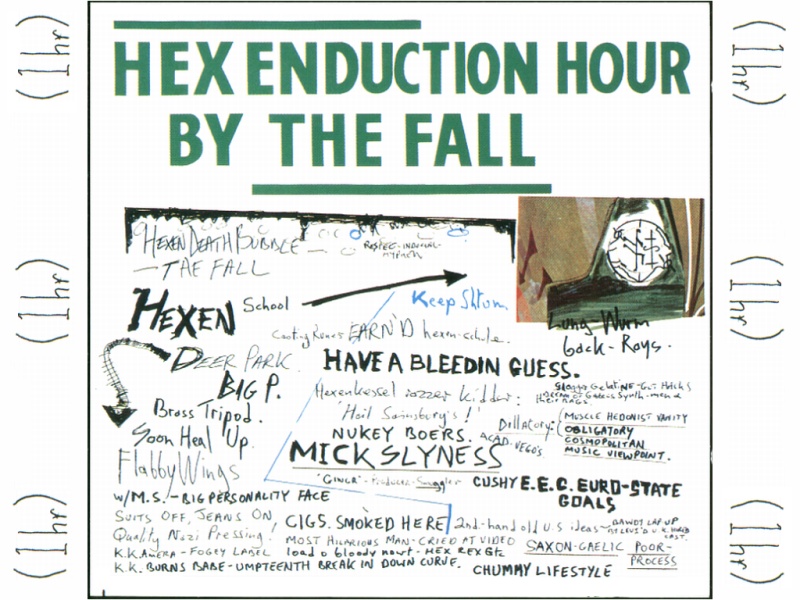
As ever, the album sleeve (so foreign to what were then the conventions of sleeve design that HMV would only stock it with its reverse side facing forward) was the perfect visual analogue for the contents. The sleeve was more than that, actually: its spidery scrabble of slogans, scrawled notes and photographs was a part of the album rather than a mere illustrative envelope in which it was contained.
With The Fall of this period, what Gerard Genette calls ‘paratexts’ – those liminal conventions, such as introductions, prefaces and blurbs, which mediate between the text and the reader – assume special significance. Smith’s paratexts were clues that posed as many puzzles as they solved; his notes and press releases were no more intelligible than the songs they were nominally supposed to explain. All paratexts occupy an ambivalent position, neither inside nor outside the text: Smith uses them to ensure that no definite boundary could be placed around the songs. Rather than being contained and defined by its sleeve, Hex haemorrhages through the cover.
It was clear that the songs weren’t complete in themselves, but part of a larger fictional system to which listeners were only ever granted partial access. ‘I used to write a lot of prose on and off,’ Smith would say later. ‘When we were doing Hex I was doing stories all the time and the songs were like the bits left over.’ Smith’s refusal to provide lyrics or to explain his songs was in part an attempt to ensure that they remained, in Barthes’ terms, writerly. (Barthes opposes such texts, which demand the active participation of the reader, to ‘readerly’ texts, which reduce the reader to the passive role of consumer of already-existing totalities.)
Before his words could be deciphered they had first of all to be heard, which was difficult enough, since Smith’s voice – often subject to what appeared to be loud hailer distortion - was always at least partially submerged in the mulch and maelstrom of Hex’s sound. In the days before the internet provided a repository of Smith’s lyrics (or fans’ best guesses at what the words were), it was easy to mis-hear lines for years.
Even when words could be heard, it was impossible to confidently assign them a meaning or an ontological ‘place’. Were they Smith’s own views, the thoughts of a character or merely stray semiotic signal? More importantly: how clearly could each of these levels be separated from one another? Hex’s textual expectorations were nothing so genteel as stream of consciousness: they seemed to be gobbets of linguistic detritus ejected direct from the mediatized unconscious, unfiltered by any sort of reflexive subjectivity. Advertising, tabloid headlines, slogans, pre-conscious chatter, overheard speech were masticated into dense schizoglossic tangles.
Who wants to be in a Hovis advert any way? ‘Who wants to be in a Hovis/ advert/ any way?’ Smith asks in ‘Just Step S’ways’, but this refusal of cosy provincial cliche (Hovis adverts were famous for their sentimentalised presentation of a bygone industrial North) is counteracted by the tacit recognition that the mediatized unconscious is structured like advertising. You might not want to live in an advert, but advertising dwells within you. Hex converts any linguistic content – whether it be polemic, internal dialogue, poetic insight – into the hectoring form of advertising copy or the screaming ellipsis of headline-speak. The titles of ‘Hip Priest’ and ‘Mere Pseud Mag Ed’, as urgent as fresh newsprint, bark out from some Voriticist front page of the mind.
As for advertising, consider ‘Just Step S’ways’’ opening call to arms: ‘When what you used to excite you does not/ like you’ve used up all your allowance of experiences’. Is this an existentialist call for self re-invention disguised as advertising hucksterism, or the reverse? Or take the bilious opening track, ‘The Classical’. ‘The Classical’ appears to oppose the anodyne vacuity of advertising’s compulsory positivity (‘this new profile razor unit’) to ranting profanity (‘hey there fuckface!’) and the gross physicality of the body (‘stomach gassss’). But what of the line ‘I’ve never felt better in my life?’ Is this another advertising slogan or a statement of the character’s feelings?
It was perhaps the unplaceability of any of the utterances on Hex that allowed Smith to escape censure for the notorious line, ‘where are the obligatory niggers?’ in ‘The Classical’. Intent was unreadable. Everything sounded like a citation, embedded discourse, mention rather than use. Smith returns to the Weird tale form on ‘Jawbone and the Air Rifle’. A poacher accidentally causes damage to a tomb, unearthing a jawbone which ‘carries the germ of a curse/ of the Broken Brothers Pentacle Church’. The song is a tissue of allusions - James (‘A Warning to the Curious’, ‘Oh, Whistle and I’ll Come to you, my Lad’), Lovecraft (‘The Shadow over Innsmouth’), Hammer Horror, The Wicker Man - culminating in a psychedelic/ psychotic breakdown (complete with torch-wielding mob of villagers):
He sees jawbones on the street/ advertisements become carnivores/ and roadworkers turn into jawbones/ and he has visions of islands, heavily covered in slime. / The villagers dance round pre-fabs/ and laugh through twisted mouths
‘Jawbone’ resembles nothing so much as a League of Gentlemen sketch, and The Fall have much more in common with the League of Gentlemen’s febrile carnival than with witless imitators such as Pavement. The co-existence of the laughable with that which is not laughable: a description that captures the essence of both The Fall and The League of Gentlemen's grotesque humour.
White Face finds roots On Hex’s second side, mutant r and r becomes r and Artaud as the songs become increasingly delirial and abstract. 'Who Makes the Nazis’ - as lunar as Tago Mago, as spacey-desolated as King Tubby at his most cavernous – is a TV talk show debate rendered as some Jarry-esque pantomime, and composed of leering backing vocals and oneiric-cryptic linguistic fragments: ‘longhorn breed… George Orwell Burmese police… Hate’s not your enemy, love’s your enemy, murder all bush monkeys…’
'Iceland', recorded in a lava-lined studio in Reykjavik , is a fantasmatic encounter with the fading myths of North European culture in the frozen territory from which they originated. ‘White face finds roots’ Smith’s sleeve-notes tell us. The song, hypnotic and undulating, meditative and mournful, recalls the bone-white steppes of Nico's The Marble Index in its arctic atmospherics. A keening wind (on a cassette recording made by Smith) whips through the track as Smith invites us to ‘cast the runes against your own soul’ (another James’ reference, this time to his ‘Casting the Runes’).
‘Iceland’ is rock as ragnarock, an anticipation (or is it a recapitulation) of the End Times in the terms of the Norse ‘Doom of the Gods’. It is a Twilight of the Idols for the retreating hobgoblins, cobolds and trolls of Europe’s receding Weird culture, a lament for the monstrosities and myths whose dying breaths it captures on tape:
Witness the last of the god men ….A Memorex for the Krakens
Sasakisan's work collected n re-constructed by artists various: Greg Davis, Hans Appelqvist, Steve Roden included. Sasakisan be no musician in strict sense but prone withal to creating journal-like pieces entire from cell phone melody composition tool. Skew whiff sketches in miniature. Nothing less than charming.
Worlds remote n dead, space deep n sombre. Expansive yet claustrophobic. A stranded nexus between something and nothing. Colour n emotion bled out in protracted keyboard drones of Eno produced ambient wash. Anaemic flickers from n exhausted star.
A step on, up and perhaps backwards. Amnesiac fog 78s sampling plunderphonics stripped away, leaving a frequently piano driven ambience recalling Harold Budd, Max Richter, and Erik Satie even. Elegiac and melancholy vacuum hum and static crackle. Kirby / Caretaker is still in mourning, though no longer for a history repressed and returned in spectral form. More straightforward modernist angst: fin-de-siècle paean to degeneration, cohesion and connectedness. More haunting than haunted.
"Discreet Music" (30:35) Recorded at Brian Eno's studio 9-5-75 Three Variations on the Canon in D Major by Johann Pachebel (i) "Fullness of Wind" (9:57) (ii) "French Catalogues" (5:18) (iii) "Brutal Ardour" (8:17) Performed by The Cockpit Ensemble, conducted by Gavin Bryars (who also helped arrange the pieces)
Since I have always preferred making plans to executing them, I have gravitated towards situations and systems that, once set into operation, could create music with little or no intervention on my part.
That is to say, I tend towards the roles of the planner and programmer, and then become an audience to the results. Two ways of satisfying this interest are exemplified on this album. "Discreet Music" is a technological approach to the problem. If there is any score for the piece, it must be the operational diagram of the particular apparatus I used for its production. The key configuration here is the long delay echo system with which I have experimented since I became aware of the musical possibilities of tape recorders in 1964. Having set up this apparatus, my degree of participation in what it subsequently did was limited to (a) providing an input (in this case, two simple and mutually compatible melodic lines of different duration stored on a digital recall system) and (b) occasionally altering the timbre of the synthesizer's output by means of a graphic equalizer.
It is a point of discipline to accept this passive role, and for once, to ignore the tendency to play the artist by dabbling and interfering. In this case, I was aided by the idea that what I was making was simply a background for my friend Robert Fripp to play over in a series of concerts we had planned. This notion of its future utility, coupled with my own pleasure in "gradual processes" prevented me from attempting to create surprises and less than predictable changes in the piece. I was trying to make a piece that could be listened to and yet could be ignored... perhaps in the spirit of Satie who wanted to make music that could "mingle with the sound of the knives and forks at dinner."
In January this year I had an accident. I was not seriously hurt, but I was confined to bed in a stiff and static position. My friend Judy Nylon visited me and brought me a record of 18th century harp music. After she had gone, and with some considerable difficulty, I put on the record. Having laid down, I realized that the amplifier was set at an extremely low level, and that one channel of the stereo had failed completely. Since I hadn't the energy to get up and improve matters, the record played on almost inaudibly. This presented what was for me a new way of hearing music - as part of the ambience of the environment just as the colour of the light and the sound of the rain were parts of that ambience. It is for this reason that I suggest listening to the piece at comparatively low levels, even to the extent that it frequently falls below the threshold of audibility.
Another way of satisfying the interest in self-regulating and self-generating systems is exemplified in the 3 variations on the Pachebel Canon. These take their titles from the charmingly inaccurate translation of the French cover notes for the "Erato" recording of the piece made by the orchestra of Jean Francois Paillard. That particular recording inspired these pieces by its unashamedly romantic rendition of a very systematic Renaissance canon.
In this case the "system" is a group of performers with a set of instructions - and the "input" is the fragment of Pachebel. Each variation takes a small section of the score (two or four bars) as its starting point, and permutates the players' parts such that they overlay each other in ways not suggested by the original score. In "Fullness of Wind" each player's tempo is decreased, the rate of decrease governed by the pitch of his instrument (bass=slow). "French Catalogues" groups together sets of notes and melodies with time directions gathered from other parts of the score. In "Brutal Ardour" each player has a sequence of notes related to those of the other players, but the sequences are of different lengths so that the original relationships quickly break down.
James Leyland Kirby strips away by gradations at phonographic fidelity, mirroring the peeling back of memories re-construing time-locked and haunting loops. Alzheimer's patients enduring memory attrition can still recall songs from their distant past. The prefrontal cortex is among the last brain regions to atrophy.
Occasionally memory and melody are lucid: Moments of Sufficient Lucidity; Camaraderie at Arm's Length; Libet's Delay. Kirby's genius is to make tangible decay and elusive manifest: Bedded Deep in Long Term Memory; I Feel as if I might be Vanishing; The Sublime is Disappointingly Elusive - and to make audible the ticking of history's metaphysical clock.
Sublime, timeless and beautiful. Like a life well lived.
Prescient and unprecedented monument to indeterminacy, electronic hiss, ruptured nostalgia, guitar / siren wail, ghostly future times past, patriotism, distant bells, radio transmissions, tape manipulation, fatal pre-war swagger, and perhaps in the end, friendship. For all the artiness of the undertaking - avant garde to its core - the "Opera" is intensely autobiographical, entirely original and completely engaging.
Ichiyanagi compares music to Japanese garden design: meticulous, painfully ordered yet always interacting with indeterminate elements - moisture, light, wind. Despite Ichiyanagi’s self-declared tilt at natural multiplicity over concentrated construct, the do-it-yourself flow of patchwork elements benefits from an intimate aleatoric framing. The details look after themselves.
To Tadanori Yokoo, magus of Japanese pop design. Like Ichiyanagi, Yokoo's multi-layered approach is highly personal and gives the lie to easy comparisons, notably "the Japanese Warhol" moniker. Modus operandi converge. Yokoo saturating and manipulating popular by-gone images in bang up to date lysergic colour; Ichiyanagi knitting traditional enka with musique concrète and psych feakout à la mode. Both artists tackle loaded themes of nationalism and nationhood: Yokoo's risqué red sun ray flag (kyoku jitsu-ki) as recurring motif; Ichiyanagi's sampling of rousing miltary marching song. More cultural reclamation than the revivalist impulse that drove contemporary - and great Yokoo friend and influence - Mishima Yukio.
The “Opera” is a multi-media affair; the importance attached to the visual side of the production well ahead of its time. Attention to sonic and visual detail - however indeterminate -as meticulous as only Japanese traditional art and crafts can be. The work is ahead of its time in other ways, as we shall see. Arguably, the rest have yet to catch up.
Side A
1 Aria ichi [Aria one] Traditional ballad setting leit motif of melancholy nostalgia.
2 Erekutorikku chanto [Electric chant] More hiss and whine than chant. "Chant" well-chosen, nevertheless, as sickly electronic Buddhist drone morphs into air-raid siren. Cue martial brass band and military singing. Oppressive and rousing; attracting as it repels. 20 years later, the likes of Current 93 and Death In June would court controversy with similar use of Nazi martial tunes. Ichiyanagi's ploy is utterly outrageous. No gimmicks here though and is of a piece with the pervasive tension between comforting nostalgia and repellent militarism.
3 Otoko no junjo [Man’s pure heart] Distant noises, footsteps, two men feeling their way into a song on skeletal piano. Complaining about the piano, they notice the environing silence: "Everybody’s gone – nobody is watching. Should we continue when there is no one?" Big question. Finally, free from background noise, the song is delivered in full.
Switch: crowd noise. Rumpus. Sports match? Riot? Protest? Woman sobbing - with fear or erotic excitement?
A low-flying aircraft passes overhead.
(1966, a group of Narita locals residents combine with student activists and left-wing political parties to form Sanrizuka-Shibayama Union to Oppose the Airport)
Side B
4 Uchida Yuya to Za Furawaazu (Uchida Yuya and the Flowers) 27-minute long psych free form freak out. 20 mins. one side, remainder on next. Ichiyanagi let loose the reins on budding young psychonauts with the sole stipulation that the piece be titled after Yokoo's signature 1965 poster I Was Dead.
The central slogan on Yokoo's poster: “Having reached a climax at the age of 29, I was dead". An inkling that on one level Ichiyanagi is having a joke at young gun expense.
Side C
5 Uchida Yuya to Za Furawaazu (Uchida Yuya and the Flowers)
Caution, mind melting in progress. 7 more minutes.
6 Nyuyooku no uta [New York song] Poem recited in Edo-jidai Japanese, then contemporary dialogue and short monogatari.
At this point, check again Ichiyanagi's integration of Yokoo thematic riffs. For instance, the "Opera" shares imagistic and sonic links to Yokoo's 1965 animation Kach Kachi Yama:
7 Kayo myuzikare [Kayo musicale] Medley: radio jingles, random commentary, film excerpt (adult scolds initially recalcitrant but ultimately pliable young woman for accepting something from a stranger), and Meiji Chocolate ad given the full Group Sound treatment chokoreeto – chokoreeto. Switch: European church bells, harpsichord looped, echoed, deconstructed. Switch: sound of massive bombing raid. End.
Adding up to what? Let's venture: a comment on corrosive Western / capitalist influence? Whether low art - reedy GS organ peddling chocolate - or high - Bach keyboards selling God - the outcome obliterates.
Side D
8 Love Blinded Ballad Uta 1969 Archival announcements, patriotic songs, marching fanfares, speeches, classical violin, military songs intermixed curvilinear fashion. Whirlwind tour through 30s & 40s public sphere. Pervading unease and eeriness recalls Derrida's hauntology. Ichiyanagi way ahead of "nostalgia for the future" curve.
And blinded by love for what exactly? Patriotism again points the way.
9 Spite Song Uta 1969 Frogs croak, waterfowl cackle, crows caw; earlier patriotic choruses hover ghostly in the background. Tchaikovsky’s Swan Lake subjected to discordant squeaking as AM radio tunes in and out of romantic cliché to the point of unlistenability. Ironically, final transition to bombing alert siren is a relief.
10 Takakura Ken, Tadanori Yokoo o utau [Ken Takakura sings to Tadanori Yokoo] Or is it more an "All Clear" signal? That would make sense as next and last up is an enka serenade by yakuza movie hard man Takakura Ken.
Ichiyanagi's choice of Takakura Ken is apposite and affectionate. Tadanori Yokoo provided commercial posters for several of Takakura’s gangster flicks and was obviously enamoured.
And so, a warm, personal ending to a disquieting, shattering journey. Enjoy the trip.